We had a new chef instructor today, and he's one of the bread gurus at the CIA. He's a veritable walking encyclopedia of all things bread. I feel that we have only scratched the surface of his knowledge. The day started with an hour or so lecture on the basics of bread baking, starting with a brief history of baking, then moving through the basic functions of the four fundamental ingredients in bread, with a thorough discussion of the various types of flours used in bread baking, as well as a discussion of the various leaveners available to bakers. I've always been fascinated by natural yeasts, so I really enjoyed the discussion on sourdough bread. I asked the chef if it was possible to use the wild yeast found in unpasteurized cider as part of a starter, and he enthusiastically said yes. You can use spent yeast at the bottom of a beer bottle, or wine, or just use any organically grown fruit to get your starter going. Nearly every fruit has yeast on it, and with the right conditions, you can use those fruits to get your starter, well, started. The best starters, however, are the ones that have been around for years. Sourdough relies on wild yeast, as well as wild bacteria. As starters age, they build up stronger and stronger antibacterial properties that protect the starter very effectively from interlopers who could spoil the party, while protecting and defending the good bacteria that helps give sourdough its distinctive twang. The chef today said that any of us who were interested could take any of the starters they have in the bakeshop home with us. Guess who’s signing up?
It's amazing the amount and variety of bread we made today. We split up into teams again and I was on ciabatta and hard roll detail. I was a little disappointed in this, since I soon discovered that with ciabatta there is very little involved in making the bread, and the hard rolls really aren't terribly exciting compared to many of the other breads we were baking. I was a tad envious of the other teams who were making French baguettes, batards, and fousales (a new one to me), as well as the teams making some of the other breads. But I made sure to step over and make a few of the more involved breads, so hopefully I have enough hand's on experience with a few of them to at least try them at home and have reasonable success.
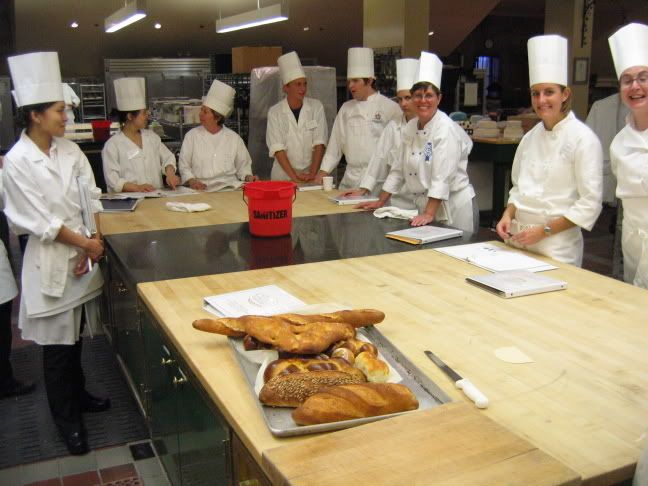
Here is a partial result of our labors:
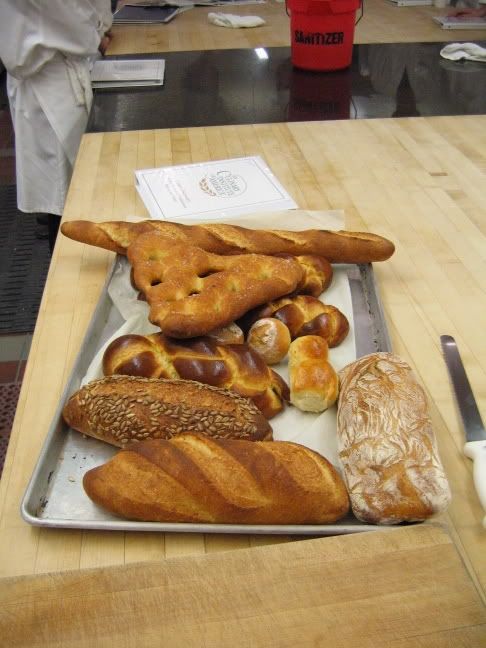
Starting in the bottom right of the pan is ciabatta, then, moving clockwise, you see a French batard. This uses the identical dough as a baguette, the only difference being in how it's shaped. Above the batard is sesame bread. It was too hot to cut into tonight, so we'll try that tomorrow. Chef Brown says that this is always the favorite of the class, and everyone else in the CIA looks forward to when our class bakes this bread so they can have some themselves --I'm looking forward to trying it tomorrow. Above that is challah, the Jewish Sabbath bread. Apparently it makes the best French toast in the world. It's a slightly enriched bread with eggs, fat and sugar, so it's softer and sweeter than the rest. I'm testing out the French toast theory tomorrow morning for breakfast here in my hotel room, which has a little kitchenette. Moving on...above the Challah is fougasses, sort of a French foccacia. This uses the same lean dough for the French baguette. It's the triangle shaped bread, by the way. After you knead it, you put several slits in the dough to cause holes to form. This is done to create more crust area, which is what the Europeans really enjoy. You brush it with olive oil and sea salt before baking, and it comes out very, very tasty. Above that is the baguette, and moving below that you can see a couple more Challah's sticking out, and then we get to the buns. The buns with the flour on it are called Schlumbergers. You basically roll those just a little bit, and then you have a little seam on the bottom. You take a little olive oil, dip your finger in it, and then push it into the seam. You proof the dough upside down, with the seam facing down on a floured sheet of canvas, called a couches. When you bake it, you turn it over, and as it bakes, it spreads a little where the olive oil went, creating a nice texture. We made Kaiser rolls as well with the hard roll dough. Going a little further in the picture you see soft rolls--we're talking Thanksgiving rolls, soft, chewy, rolls that feel like home. There were several forms we made with the soft dough: Parker House rolls, clover leaf rolls, and dinosaur rolls, which just means they have sort of fins on top of the roll, which makes them have a bit more texture.
This wasn't all we made though. The sourdough bread is proofing (read: rising) overnight, as well as the rosemary and rosemary/olive bread. We also made panettone, a sweet, cake-like bread that was pulled from the ovens just as we finished for the evening. We'll try those tomorrow.
This was the most satisfying day of the week for me. Working with the dough, using starters that have been around for a long time, and working with a guy who's passion is bread was one of the most satisfying things I've done in a long time. I never really looked forward to baking bread in the past, I think primarily because I always failed miserably at it. In fact, as I looked towards this week, I was disappointed that two days were covering bread. But now, I've completely changed my mind. I think when I look back on the week, this section working on bread will be what I come back to the most in my recollections. I think in large part, this is mainly due to the fact that it’s all new to me. I've made pies before, and baked cakes and cookies. I learned better ways to do those things I've already done in the first two days, (which were terrific), but learning and succeeding at something which has always stymied me in the past was very, very satisfying. I think most of us enjoyed this immensely today. Seeing those breads come out of the oven, and realizing that those loafs were basically the same as loafs that we'd pay money for in a high-class bakery was exhilarating. And man, were they TASTY! Every single one of them tasted amazing, and was just right. The crust on the French breads was nice and chewy with a soft, tender, bubbly center, and the Challah was sweet, light and tender--all of it was so, so good.
I think there's something very elemental about baking bread. It takes time--it's slow, and it's alive. It's finicky, and has a mind of it's own. It's very earthy and raw in my mind. It's different than pastry in that regard. Bread is temperamental, as if it has a personality. You have to be gingerly with it for the most part, but then there are times when you need to rough it up a bit to tame it. Beyond that, it's obvious that bread binds people together. We've been baking bread for about 7,000 years, in nearly every culture across the world. It's essential to our life. Just think about how bread weaves its way into our culture. We "break bread together," and there's something very communal about passing a loaf of beautifully crusty bread from one person to the next, all of us eating from the same loaf. We did this in our class, passing each loaf to the person next to us. There's something very friendly about bread, I think. And of course bread is sacramental at times. Christ is the bread of life, and was broken, to be consumed by us. Powerful symbolism and meaning there. To make EXCELLENT bread today was incredibly satisfying. I know I've used that phrase already, but that sums it better than anything. I think in large ways that satisfaction came from how well those loaves turned out. Excellence holds great appeal for me, and baking such excellent bread today was remarkably fun.
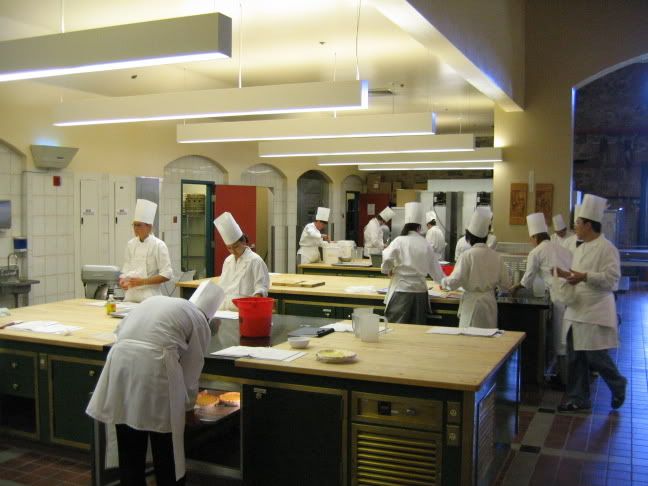
I figured it's high time I posted some photos of my environs, so here's a little tour of the teaching kitchens.
This is what you see as you first enter the teaching kitchens, which are housed on the third floor.
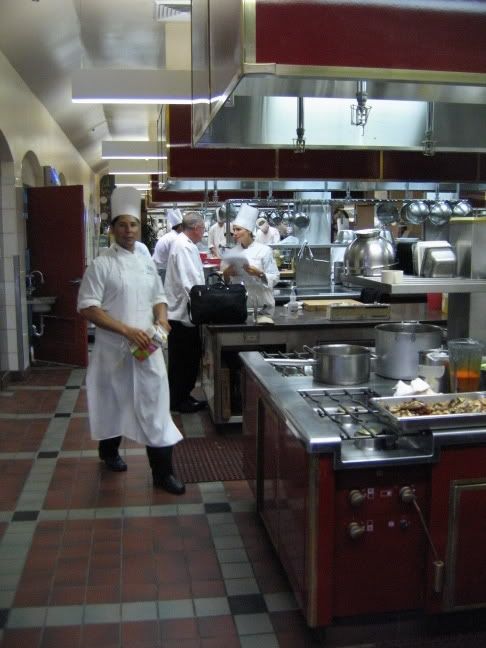
This is what you see as you first enter the teaching kitchens, which are housed on the third floor. Once you open the door, however, the first thing you notice is the smell, an onslaught of enticing aromas wafting up from all around the teaching kitchen. As you walk along row after row of massive cook tops and workspaces, the smells evolve, changing as you go from one dish in progress to the next. Here you see bones roasting on top of the stove, perhaps the first step in making stock. On the next station, a chicken stock nearing completion, simmering away. Over there you see, smell, and hear vegetables sautéing in a pot. There is amazing energy happening in these kitchens, and a constant buzz of pots clamoring, food sizzling, knives meeting chopping blocks. It's exciting, and it's different every day.
Another shot of the teaching kitchen, from the other side:
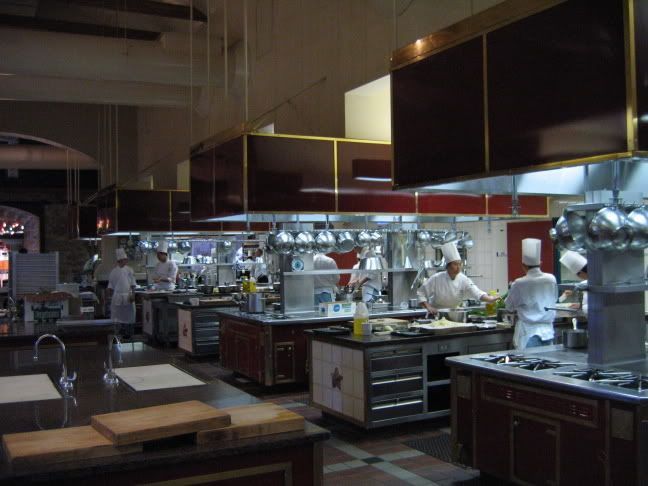
On the far side of the teaching kitchens is the domain of baking and pastry.
Here is a picture of the students involved in the 30-week baking and pastry certification program. They’re nearing completion, and are currently working on cake decorating. I think today they were studying fondant.
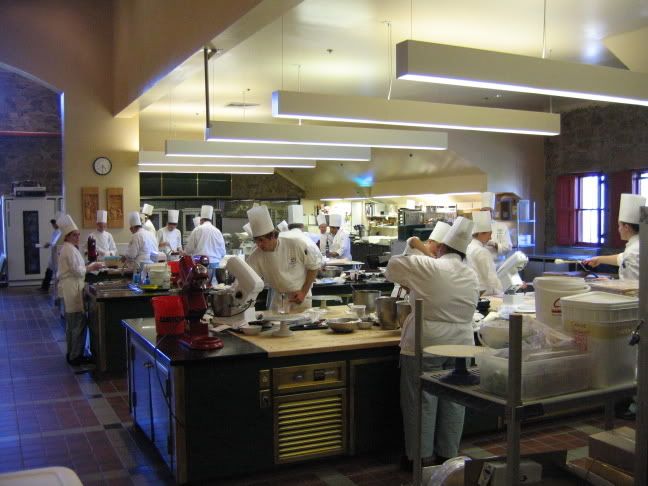
And here is a picture of our workstations, opposite the other pastry students.
And here's a picture that includes some of my classmates. It was sort of a half-hearted effort to get everyone to smile.
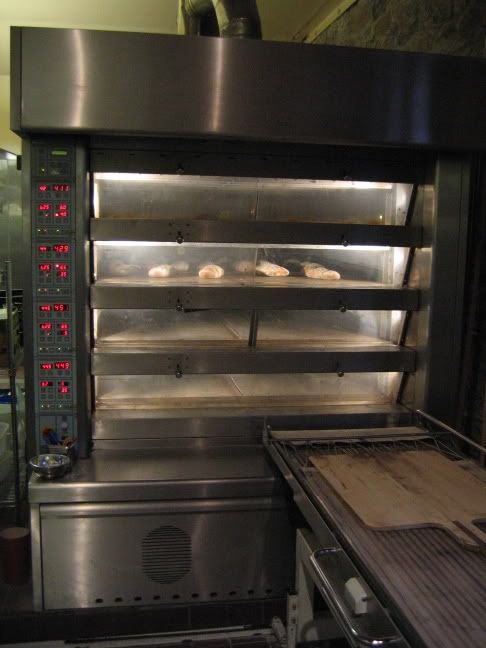
And finally, here's a picture of the oven with my team's loaves of ciabatta baking away. It's a massive oven, in which you can bake 300 loaves at once. Impressive.
Off to bed now.


No comments:
Post a Comment